Showing posts with label 1810. Show all posts

Wednesday, May 15, 2013

A long-lived life at Riversdale near Bladensburg - 120 years old in 1810


LONGEVITY

               Died on Sunday, the 120th instant. at the plantation of George Calvert, Esw. Prince George's county, negro JACK, in the 120th year of his age. - He retained every faculty in a remarkable degree to the last. [1]

Riversdale
Riverdale Park, Maryland 20737


[1] Federal Republican & Commercial Gazette; Date: 05-28-1810; Volume: II; Issue: 201; Page: [3]; Location: Baltimore, Maryland.
Transcribed by John Peter Thompson, May 15th, 2013. 

Sunday, May 5, 2013

Buy American Made and Make Money too - Columbian Agricultural Society May 5th, 1810


At a meeting of the standing committee of the Columbian Agricultural Society, held at the Union Tavern, Georgetown, on Wednesday the 13th day of December, A. D. 1809, it was determined that the following premiums be given at the general meeting of the society on the 16th day of May next, viz.

               Premium 1 - One hundred dollars[1], for the best two-toothed ram lamb.
               Premium 2 - Eighty dollars, for the next best two-toothed ram lamb.
               Premium 3 - Sixty dollars, for the third best two-toothed ram lamb.

               Best (applied to the above articles) as to quality of wool, and quantity in proportion to carcass.

               Premium 4 - Thirty dollars, for the best piece of cotton cloth, proper for men's coats or women's dresses, not less than ten yards.
               Premium 5 - Thirty dollars, for the best piece of fancy patterns for vests, not less than ten yards.
               Premium 6 - Thirty dollars, for the best piece of cotton cloth, suitable for pantaloons or small clothes, not less than ten yards.
               Premium 7 - Twenty dollars, for the best pair of cotton counterpane, full size.
               Premium 8- Twenty dollars, for the best pair of cotton stockings, large size.
               Premium 9 - Thirty dollars, for the best piece of hempen or flaxen sheeting, at least ten yards.
               Premium 10 - Thirty dollars, for the best piece of hempen or flaxen shirting, not least than ten yards.
               Premium 11 - Thirty dollars, for the best piece of hempen or flaxen table linen, not less than ten yards.
               Premium 12 - Ten dollars, for the best pair of hempen or flaxen thread socks, full size.
               Premium 13 - Twenty dollars, for the best piece of twilled bagging, or hemp, flax or cotton, at least ten yards.
               Premium 14 - Twenty dollars, for the best piece of bedticking,, of hemp, flax or cotton, or in part of all, or either, not less than ten yards.

               All premiums shall be judged at one of the general meetings of the society, by a board of five members appointed by the president, and standing committee, from among such disinterested persons as may be present.

               The society will lay no claim to any article for which a premium has been awarded, but the owner or exhibitor may, immediately after adjournment of the society, on the day of exhibition, remove such article and dispose of it at pleasure.

               The premiums will be paid in cash, or in plate of equal value, with suitable devices, at the option of the fortunate competitor.

               Premiums to the amount of least five hundred dollars will be given at the fall meeting of the society, for neat (sic) cattle, woollen (sic) manufactures, native dyes, written essays, &c.

               It is earnestly recommended by the committee, that every member appear at the meeting of the society, dressed in home manufactures.[2]
                                             DAVID WILEY, Secretary[3]


[2] Alexandria Daily Gazette, Commercial & Political; Date: 05-05-1810; Volume: X; Issue: 2783; Page: [2]; Location: Alexandria, Virginia.
Transcribed by John Peter Thompson, May 5th, 2013.

[3] The scientific agricultural magazine of the Columbian Agricultural Society of Georgetown, District of Columbia, was an octavo consisting of 32 pages. It was the first periodical devoted strictly to agriculture. It was published by the Columbian Agricultural Society.[2][9] The publisher was W. A. Rind of Georgetown, Washington, D.C.

The editor was a Reverend David Wiley who was a minister that moved to Georgetown in 1800. Rev. Wiley was in charge of the Columbian Agricultural Society and was its secretary and teacher. The society was established for the purpose of inspiring local agriculture manufactures. The magazine was a branch of the society that discouraged imported products. Wiley was Georgetown's postmaster, superintendent of the turnpike, merchant, miller, and the major.  from Wikipedia

Tuesday, April 2, 2013

Political Attacks on Presidents - Nothing New in Politics and Punditry - 1810


MEMORY OF WASHINGTON

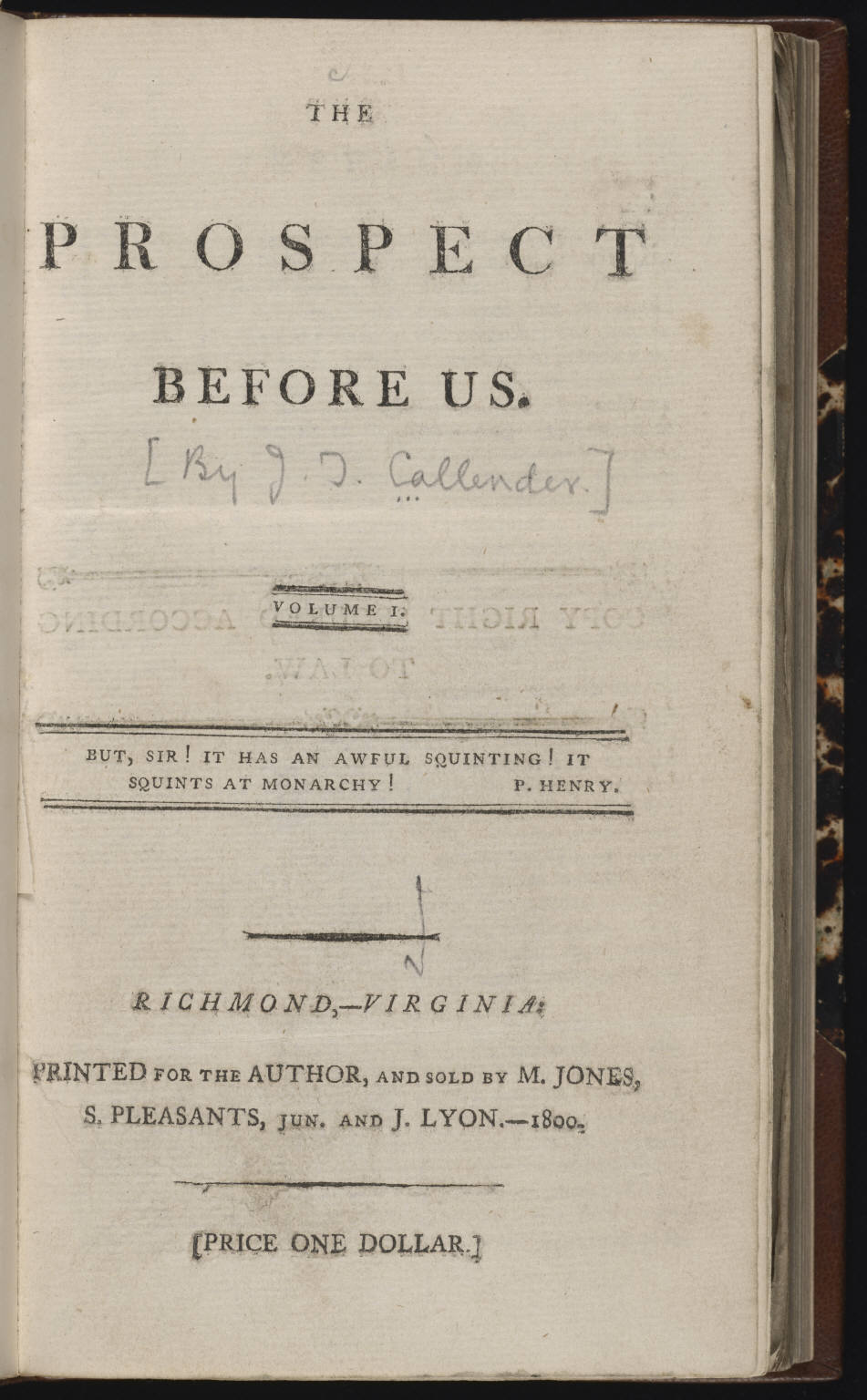
                For writing the "Prospect before us" Jefferson paid and praised Callendar [sic];[1] and unconstitutionally returned his fine after it had been paid.  When, therefore, such numbsculls as Niles and Mitchell the former admirers of Callendar and the present worshippers of his suborner Jefferson, affect to speak reverendly of the memory of Washington, it is arrant dissimulation.   It is impossible for the same heart to contain both sentiments; one must jostle with and displace the other.

               Among other fiend-like aspersions and outrages upon the dead hero, paid for by the infamous Jefferson, take the following as a sample:

From the "Prospect before us"

               "The REPUBLICANS[2] were extremely well satisfied with the demise of the general!!!!  They felt and feared his weight in the scale of aristocracy but they found it necessary to preserve appearances with the multitude, by presenting an appearance of sorrow -  With regard to the mausoleum, the man who shall vote one shilling for it must outgo the guilt of the robber and the house-breaker without their personal temptation.  A plain tablet may perhaps be found expedient as a sacrifice to popular ignorance and enthusiasm."[3]
[p.70.

Callender's Pamphlet
image: Wikipedia


[1] The Sedition Act Trials — Historical Background and Documents.
History of the Federal Judiciary. [accessed April 2, 2013] http://www.fjc.gov/history/home.nsf/page/tu_sedition_hd_jc_indictment.html
"James Callender was the author of some of the most extreme and provocative language penned by any of the Republican newspaper writers during the Adams administration. After gaining notoriety for newspaper editorials in Philadelphia and Richmond, Callender was indicted in the U.S. Circuit Court for the District of Virginia for writing a lengthy pamphlet in favor of Thomas Jefferson’s election as President. The Prospect Before Us took the form of a political history of the 1790s, with special emphasis on the supposed corruption and monarchical principles of John Adams and his administration. Jefferson reviewed a draft of the pamphlet and predicted, in an intentionally unsigned letter to Callender, that “such papers cannot fail to produce the best effect.” Callender made sure that his pamphlet was reprinted in several cities, and he brazenly sent a copy to President Adams."
[2] The Democratic-Republican Party was the political party organized by Thomas Jefferson and James Madison in 1791-93. It stood in opposition to the Federalist Party and controlled the Presidency and Congress, and most states, from 1801 to 1824. from Wikipedia see also: Federalist Party vs. Democrat-Republicans
[3] Federal Republican & Commercial Gazette; Date: 04-02-1810; Volume: I; Issue: 153; Page: [2]; Location: Baltimore, Maryland
Transcribed by John Peter Thompson