Showing posts with label Politics. Show all posts

Sunday, July 6, 2014

Citizenship - Better Late than Never - March 1828

New-Orleans Argus; Date: 03-10-1828 
NATURALIZATION.

            The new naturalization bill, reported to Congress from the Judiciary committee, provides—
            "any alien being a free white, who was residing within the limits and under the jurisdiction of the United States between 14th April, 1802, and 18th June, 1812, and who has continued to reside within the same, may be admitted to become a citizen of the U. States, without having made any previous declaration to become a citizen: Provided that whenever any person, without a certificate of such declaration of intention shall make application to be admitted a citizen of the U. States, it shall be proved to the satisfaction of the court, that the applicant was residing within the limits and under the jurisdiction of the. U. States before 18th June, 1812, and had continued to reside within the same, or he shall not he admitted. And the residence of the applicant within the limits and under the jurisdiction of the United States for at least five years immediately preceding the time of such application shall be proved by the oath or affirmation of citizens of the U. States, which citizen shall be named in the record as witnesses.— And such continued residence within the limits and under the jurisdiction of the U. States, when satisfactorily proved, and place or places where the applicant has resided for at least five years as aforesaid, shall be stated and set forth, together with the names of such citizens, and the record of the court, admitting the applicant; otherwise the same shall not entitle him to be considered and deemed to citizen of the. U. States.[1]


[1]  New-Orleans Argus; Date: 03-10-1828; Page: 2; Location: New Orleans, Louisiana
 Transcribed by John Peter Thompson. 6th July 2014.

Saturday, June 28, 2014

Political Conspiracies are Nothing New - June 28, 1814 Barney and the Dems Conspire to Harm Federalists Party in Maryland


            It is currently reported and believed in St. Mary's, Charles and Calvert counties, and in the exposed parts of Prince George's, that Barney's flotilla into the Patuxent for no other purpose than to bring the war into those federal counties, and thus to divert the attention of the enemy from Baltimore and Washington.[1] The circumstances mentioned to support this statement are strong, if not conclusive. In the first place the flotilla was equipped to defend Baltimore harbor, and it was understood not to leave there. Secondly, Barney ran into the Patuxent when it had been in his power to get into the Potomac, if he was ordered their. Thirdly, instead of running into St. Leonard's Creek, if he had proceeded up to Nottingham or pinpoint, a small place 7 miles higher up, he might then have defended himself  effectually, sloops of war being unable to follow him. And, if necessary, he might have carried barges across on rollers from pinpoint to the Chesapeake, only 9 miles. It would not have been the first time that gunboats were seen in cornfields. But they could have been left in safety. If Barney was ordered to the Patuxent for the purpose suppose it, it was a most wicked and wanton act the executive. —[2]


[1] Hoey, John B. Copyright 1995-2014.  "Federalist Opposition To The War Of 1812
Engaged in a War That Was To End In A Stalemate, Did America's Founders Miscalculate Its Military Institutions?" {accessed from the web June 28, 2014: http://www.earlyamerica.com/review/winter2000/federalist.html]

The Federalists opposed the war for several specific reasons. For one thing, they saw it as a party war designed to further the interests of Republicans and to silence the opposition ~n a view that was reinforced by the Baltimore Riots in 1812 and the refusal of the administration to accept Federalists into the Cabinet in1814. "I regard this war, as a war of party, and not of the country," said Rufus King in 1812. "The people are no more obliged "O to approve and applaud the measure," added the United States' Gazette, "than "O any other party project."

The Federalists also feared that the war would throw the nation into the arms of Napoleon, who was variously described as "the great destroyer," "the little tyrant," the "monster of human depravity," and "the arch-fiend who has long been the curse and scourge of the European World." The initial protests against the war, particularly in New England, often expressed greater fear of a French alliance than of the war itself. "The horrors of war, compared with it, are mere amusement," said Timothy Dwight. "The touch of France is pollution. Her embrace is death." French Dominion, added William Ellery Channing, threatened not just the wealth, but "the minds, character, morals, and the religion of our entire nation."

Even after the danger of a French alliance had receded, Federalists continued to oppose the war because they considered it an "offensive" war aimed at Canada. Although willing to support a war to protect American commerce or to defend the nation's frontiers, they refused to sanction the conquest of Canada. "Let it not be said," Congressman Morris Miller of New York told the Republicans in 1813, "that we refuse you the means of defense. For that we have always been ~n we still are ready to pen the treasure of the nation. We will give you millions for defense; but not a cent for the conquest of Canada ~n not the ninety-ninth part of a cent for the extermination of its inhabitants."

[2]  Salem Gazette.; Date: 06-28-1814; Volume: XXVIII; Issue: 51; Page: [2]; Location: Salem, Mass
Transcribed by john Peter Thompson, 28th June 2014.

Monday, March 3, 2014

Gen. A. T. Mason, of Virginia, is no more - Duel at Bladensburg Feb. 6th, 1819


Alexandria Gazette Office,
Saturday; Feb. 6 —1 P. M.
MELANCHOLY EVENT.

            It has become our painful duty to announce that Gen. A. T. Mason, of Virginia, is no more. He this morning fell in a duel with J. M. McCarty, Esq. the parties met at Bladensburg, Maryland, at 10 A. M. with Marine muskets, and fought at the distance of 10 paces. General Mason received Mr. McCartney's fire in the heart, and instantly expired. The latter was wounded in the arm, but not severely. Mr. McCarty, accompanied by his friend, arrived in town at 12 o'clock. The sensation produced among our citizens, at this truly heart–rending intelligence, has never been equaled; and among the variety of rumors it is impossible to obtain all the circumstances correctly.

            The quarrel originated at the last election for Congress in Loudon County, Virginia, when gen. Mason was the democratic candidate. A long controversy ensued in the public prints, and it was believed that the interference of friends had amicably adjusted the difference. But the event has proved otherwise;— the arbitrary rules of honor have demanded that blood should be shed, and the life of general Mason has been the sacrifice. Both the parties were of high standing. The deceased was the late senator in congress from Virginia, and the survivor elected last spring a member of the house of delegates.[1]


[1] Alexandria Gazette & Daily Advertiser; Date: 02-08-1819; Volume: XIX; Issue: 5456; Page: [2]; Location: Alexandria, Virginia.

Transcribed by John Peter Thompson. March 3rd, 2014.

Saturday, February 8, 2014

Restricting Who Can Vote is Nothing New - 1814


BALTIMORE PATRIOT.
"Free-trade and no impressment. "
TUESDAY EVENING, FEB. 8, 1814.
THE DISFRANCHISING [sic] PROPOSITION.[1]

               We rejoice to find, that the public nerve of Maryland is yet sensitive. — We rejoice to find, that the voice of public indignation rings loud against the proposition, which we noticed yesterday. A few, to be sure, urge that as the monster was strangled so soon; though can ought to record its obituary. But the general voice more correctly cries aloud for an exposure of the infamy of its parents. But, how can we expose it more fully, friends, and to state the fact. This we shall continue to do— Yes; a Federalist proposed to disenfranchise the militiamen of Maryland; if they dared defend their country. "Tell it in gas!  Publish it in the streets of Askelon!"[2]

               But, we renew this subject, for the purpose of proving to the people, that it is not narrowly the soldier, in defense of the state, that the Federalists would make a slave of; but, everyone, who did not come up to their standard of merit, viz. property. The intelligent and sensible of those states, which retain property qualifications, it is believed, at this day, generally admit their futility. It seems now generally conceded, that and the protection of life, liberty and property is the object of civil government; it is very absurd to say, that those who have not the last, shall have no voice in choosing those, who are to protect the two first, far more important as they are. In the words of a good writer," it seems at length to be pretty generally admitted, that the love of country, and the practice of virtue, are not confined to the men of property; that patriotism and political rectitude are as common among the laboring poor, as among the drowsy rich."  Paulding, Williams and Van Wert, where of the class of incorruptible poor; Arnold and Hutchinson, were rich and traitors to their country. If human happiness be the legitimate aim and in the government, and if man, not in animate, matter not property, B it's true object; then it follows, that it is from men, not from property, that the general will or the government principle is to be collected."

               In Maryland, however, there are few, if any, of either party, who openly denied the correctness of [?] reasoning. But, which party have [sic] acted in conformity to it?

               In 1800, the delegates were Democratic, and the Senate federal. The Democrats proposed an abolition of property qualification. The federal Senate opposed it, and instead of it, attempted to hamper the right of suffrage still more; by requiring not merely a property qualification, but an assessment on the assessor's books. In 1801 and 1802, the Democrats obtain the ascendancy in both branches, and established universal suffrage by ballot, on the overthrow of all property qualifications. Thus, not only rationally extending the right to all, who were to live under the laws; but protecting by the ballot, from that chance which might occur of browbeating the poor man, by the purse-proud dictator.[3]

               But, with their present majority, fraudulently and infamously obtained, by cheating the people of Allegany [County,] you see citizens of Maryland, the tories [sic] are playing their old game. True, they shrunk from the trial. But they showed to you, what they would do, if they dared. They thrust forward the cloven-foot, though they were anxious afterwards took drawback, and height.[4] —  There cannot be a shadow of doubt, that the men, who would even think of depriving the militia man, in the service of his state and country, of his rights as a voter, wood, if they dared, gladly send ballot boxes on board Cockburn's fleet; and take the votes of men actually in his Majesty's service, to choose those, who wished to aid it.[5]


[1] DISENFRANCHISE:  to deprive of a franchise, of a legal right, or of some privilege or immunity; especially :  to deprive of the right to vote. © 2014 Merriam-Webster, Incorporated

[2] "Tell it not in Gath, publish it not in the streets of Askelon; lest the daughters of the Philistines rejoice, lest the daughters of the uncircumcised triumph." 2 Samuel 1:20  Readers in 1814 would have instantly made the connection.

[3] Baltimore Patriot & Evening Advertiser.; Date: 02-08-1814; Volume: 3; Issue: 32; Page: [2]; Location: Baltimore, Maryland.

Transcribed by John Peter Thompson, February 8th, 2014.

[4] Religious reference to Satan (the Devil in the Christian Bible; therefore, Evil) that would have been instantly known to all readers in 1814.

[5] Admiral of the Fleet Sir George Cockburn, 10th Baronet GCB   22 April 1772 – 19 August 1853) was a Royal Navy officer. As a captain he was present at the battle of Cape St Vincent in February 1797 during the French Revolutionary Wars and commanded the naval support at the reduction of Martinique in February 1809 during the Napoleonic Wars. He also directed the capture and burning of Washington on 24 August 1814 as an advisor to Major General Robert Ross during the War of 1812. He went on to be First Naval Lord and in that capacity sought to improve the standards of gunnery in the fleet, forming a gunnery school at Portsmouth; later he ensured that the Navy had latest steam and screw technology and put emphasis of the ability to manage seamen without the need to resort to physical punishment. {Wikipedia: http://en.wikipedia.org/wiki/Sir_George_Cockburn,_10th_Baronet]  

Saturday, February 1, 2014

Security or Liberty? The more things change; the more they stay the same. US Congress January 1814

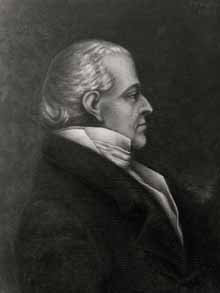
Robert Wright (1752-1826)
Senator, Governor, Congressman, Judge
Artist: Wightman, J. Pinkney (1896)
Maryland State Archives MSA #:MSA SC 1545-1007
Location : Legislative Services Building, Maryland


The following remarks on Wright's Resolution, in the House of Representatives of the U. S.  to suspend the right of trial by jury, and to substitute Martial Law in lieu thereof, are copied from the Ev. Post.[1]   

               Martial Law . — In a paroxism [sic] some of rage and madness at the disappointment they have met, with in their attempts to carry on a war against the opinions and feelings of the people in a great and powerful section of the union, the administration have [sic] had the desperate hardihood to propose, by one of their leading members in Congress, to tear from the citizens of this country the right to trial by Jury.   This right, on which more perhaps than on any other, depend the lasting existence of a free government; this right, sacredly securing to the citizen in all criminal cases by the Constitution, has been vitally attacked on the floor of Congress, and an attempt made to deprive the accused of it under the awful charge of HIGH TREASON itself; a charge the most heinous that can arise between the government and the citizens, involving life, death and confiscation. Yes, fellow-citizens, governor Wright of Maryland[2], one of the leading members on the side of the administration, has brought forward a formal resolution to extend the rules and articles of war two spies, to all the Citizens of the United States.  This, if adopted, will expose every man residing near a camp, to the bloody vengeance of any villian [sic]  who may happen to be commander in chief. If only to corrupt wretches can be found to charge the most respectable citizen who may happen to visit a camp, or to live near it, with being a Spy, this commander may seize him in an hour, try him by a hand of subservient officers the next, and the third hang him on the first tree.[3]


[1] Northern Whig; Date: 02-01-1814; Volume: VI; Issue: 5; Page: [2]; Location: Hudson, New York
Transcribed by John peter Thompson, February 1st, 2014.

[2] Robert Wright (1752-1826) MSA SC 3520-1425: Governor of Maryland, 1806-1809 (Democrat) Archives of Maryland (Biographical Series)  [http://msa.maryland.gov/megafile/msa/speccol/sc3500/sc3520/001400/001425/html/1425bio.html]

Military service:
            Private, Captain James Kent's Militia Company, 1776
            Captain, Col. William Richardson's battalion of the Maryland Line, commissioned July 1777,
            mustered out in October 17779
Positions held:
          Admitted to the bar, 1773; lawyer
            Maryland House of Representatives, 1777-1778; 1780, 1784; 1786-1787; 1791-1792
            Maryland Senate, 1801
            U.S. Senator, 1801-1806
            Governor of Maryland, 1806-1809
            Clerk, Queen Anne's County, 1810
Ø  U.S. Representative, 1810-1817, 1821-1823
            Associate Justice, Second District, 1823-1826
[3] The Wright Resolution was referred to the House Committee of the Whole in January 1814 as an Order of the Day for the follwing Friday after the debate; it was never called up and, therefore, never acted upon. Abridgment of the Debates of Congress, from 1789 to 1856: May 24, 1813-March 3, 1817: 1813-1817
Volume 5  

Saturday, January 18, 2014

Advice for Political Parties: "Party Contentions" - January 1814


PARTY CONTENTIONS.

AN EXTRACT.

               It were well, if, instead of the bitterness and contumely of party contentions, men would learn to cultivate the end available and endearing ties of good friendship _ to permit party poison to pollute the sacred fountain of fellowship, and extend its baleful breath into the sweetest comforts of society, is robbing life of half its fleeting joys. Is the path of life so carpeted with bliss, that we need press causes of discontent into its transitory period? To soften that as severity which a difference in political opinions sometimes produces in the heart, should be the study of every man, whatever his sentiments, whatever his situation.

               The world is but one wide family, upon which the common parents look with an eye of equal protection and impartiality! How absurd, then, too – the draught of life with the nauseous dregs of jealousy, malice and contention! Let Minton consider their fellow men, like themselves, fallible; and not attribute to depravity of heart that which simply construed is but an error of judgment. Let them leave personal invective for manly argument; and endeavor to convince, rather than to irritate. Next reason prescribed bounds to enthusiasm, and their difference of opinion will cease to excite that degrading spirit of intolerance, so disgraceful to the dignity and benevolence of nature.[1]


[1] Republican Star or Eastern Shore General Advertiser; Date: 01-18-1814; Volume: 12; Issue: 20; Page: [3]; Location: Easton, Maryland.

Transcribed by John Peter Thompson January 18th, 2014.

Saturday, July 20, 2013

A Partial Bibliography - Agricultural and Political Life in Bladensburg, Maryland - 1814

Anon, 1836. A General History of the Tobacco Plant: Intended as an Authoritative Reference to Its Discovery, Dissemination, and Reception as a Luxury, Newcastle upon Tyne: Pattison and Ross. Available at: http://books.google.com/books?id=W-UWAAAAYAAJ.

Biddle, J.F., 1953. Bladensburg: An Early Trade Center. Records of the Columbia Historical Society, Washington, D.C., 53/56, pp.309–326. Available at: http://www.jstor.org/stable/40067682.

Bozman, J.L., 1837. The history of Maryland: from its first settlement, in 1633, to the restoration, in 1660 ; with a copious introduction, and notes and illustrations, J. Lucas & E.K. Deaver.

Buchholz, H.E., 1908. Governors of Maryland: from the revolution to the year 1908, Williams & Wilkins company.

Calvert, R.S., 1992. Mistress of Riversdale: The Plantation Letters of Rosalie Stier Calvert, 1795-1821 illustrate. M. L. Callcott, ed., Johns Hopkins University Press. Available at: http://books.google.com/books?id=m9rxARyL5hcC.
Abstract: he book features letters from Rosalie Stier Calvert, a wealthy Belgian woman who married in to one of Maryland’s most prominent families after emigrating to America in the late 18th century. Her family ultimately returns home while she stays with her new husband, affording her the opportunity to write many letters detailing life in early America. ~ Book Review: Mistress of Riversdale By Brian. 


Carr, L.G. et al., 1991. Robert Cole’s World: Agriculture and Society in Early Maryland, Institute of Early American History and Culture. Available at: http://books.google.com/books?id=0eFwYcDLQigC.

Abstract: In 1652 Robert Cole, an English Catholic, moved with his family and servants to St. Mary’s County, Maryland. Using this family's story as a case study, the authors of Robert Cole's World provide an intimate portrait of the social and economic life of a middling planter in the seveneenth-century Chesapeake, including work routines and agricultural techniques, the upbringing of children, neighborhood relationships and community formation, and the role of religion. The Cole Plantation account, a record that details what the plantation produced, consumed, purchased, and sold over a twelve-year period, is the only known surviving document of its kind for seventeenth-century British America. Along with Cole's will, it serves as the framework around which the authors build their analysis. Drawing on these and other records, they present Cole as an exemplar of the ordinary planter whose success created the capital base for the slave-based plantation society of the eighteenth century.

Fields, B.J., 1985. Slavery and Freedom on the Middle Ground: Maryland During the Nineteenth Century, Yale University Press. Available at: http://books.google.com/books?id=DNd5_LRxjt8C.
Abstract: Probing the relationships among Maryland’s slaves and free blacks, its slaveholders, and its non-slaveholders, Fields shows how centrist moderation turned into centrist immoderation under the stress of the Civil War and how social channels formed by slavery established the course of struggle over the shape of free society. In so doing, she offers historical reflections on the underlying character both of slave society and of the society that replaced it.

Gottschalk, L.C., 1945. Effects of Soil Erosion on Navigation in Upper Chesapeake Bay. Geographical Review, 35(2), pp.219–238. Available at: http://www.jstor.org/stable/211476.
Abstract: Alfred M. Rives, engineer in charge of a survey of bridges across the Potomac, who wrote, in 1857:13 Examination of old charts, as well as reflections upon the necessary operations of nature, convince me that these flats date from a period long antecedent to the erection of the cause? way. That they have increased rapidly during the past fifty years is but natural, when we consider what vast deposits must result from the freshet waters of the Potomac, now rendered doubly turbid from washing the shores of a highly cultivated region. It must be evident that ploughed hill sides furnish more alluvial deposit than unbroken forests or grassy slopes. By the operation of these and similar causes, many ports, formerly deep and accessible, now scarcely exist, of which Bladensburg, in our immediate vicinity, and others on our rivers of the Atlantic seaboard, are familiar examples.

Heidler, D.S. & Heidler, J.T., 2004. Encyclopedia of the war of 1812, Annapolis: U S NAVAL INST Press. Available at: http://books.google.com/books?id=_c09EJgek50C.

Holmes, O.W., 1948. Stagecoach Days in the District of Columbia. Records of the Columbia Historical Society, Washington, D.C., 50, pp.1–42. Available at: http://www.jstor.org/stable/40067314.
Abstract: The stages met and exchanged passengers at a tavern in the vicinity of the present town of Laurel that was then kept by Thomas Rose.3 Here the passengers also dined. For the first few years the Potomac crossing was at Alexandria, not at Georgetown. From the Maryland side of the ferry the stage travelled up to Bladensburg on the road that ran east of the Anacostia River.4 The fare between Baltimore and Alexandria was $3.00. The proprietors “presumed this commodious and speedy method of travelling will meet with due encouragement,” but the trip apparently consumed the entire day.

Johnson, W., 1999. Soul by Soul, Harvard University Press. Available at: .
Abstract: The focus of this book is on nineteenth-century New Orleans and the slave market that emerged then and there. More than other workings of slavery, slave markets reduced humans to commodities with prices. In particular, this book is interested in the story of slave showrooms, which held up to 100 slaves and where appraisals, accountings, back-room dealings, and other activities took place. The book attributes the slave trade to mercantilism whereby colonial imports serviced and stocked metropolitan centers and generated profits secured for both state-sponsored companies and the monopoly-granting state itself. Companies with well-connected leaders and government ties could gain state privileges and favors and receive special monopoly licenses to dominate trade, first in goods such as tobacco, indigo, rice, cotton, coffee, and so on, and later in human beings. The ban of the international slave trade in 1808 did not lead to the reduction or softening of slavery, but rather to new shapes and manifestations of slavery, especially as slave populations moved increasingly from the upper to the lower South. The ban led, more importantly for the purposes of this book, to the domestic slave trade. The domestic slave trade intensified during the rise of the cotton kingdom. The price of slaves changed with the price of cotton until the 1850s.

King, J.A., 1997. Tobacco, Innovation, and Economic Persistence in Nineteenth-Century Southern Maryland. Agricultural History, 71(2), pp.207–236. Available at: http://www.jstor.org/stable/3744247.

Kulikoff, A., 1986. Tobacco and Slaves: The Development of Southern Cultures in the Chesapeake, 1680-1800, University of North Carolina Press. Available at: http://books.google.com/books?id=NCvU9_bj-1QC.
Abstract: A major reinterpretation of the economic and political transformation of Chesapeake society from 1680 to 1800. Building upon massive archival research in Maryland and Virginia, Allan Kulikoff provides the most comprehensive study to date of changing social relations?among both blacks and whites?in the eighteenth-century South. He links his arguments about class, gender, and race to the later social history of the South and to larger patterns of American development.

McWilliams, J.W., 2011. Annapolis, City on the Severn: A History, Johns Hopkins University Press. Available at: http://books.google.com/books?id=9NJzbC_mlpkC.
Abstract: The story of Annapolis resonates in every century of American history. Annapolis has been home to tobacco plantations, political intrigue, international commerce, the U.S. Naval Academy, ballooning population growth, and colonial, state, and national government. Jane Wilson McWilliams’s captivating history explores Annapolis from its settlement in 1650 to its historic preservation campaign of the late twentieth century. McWilliams brings alive the people of Annapolis as she recounts their fortunes and foibles. Be they black or white, slave or master, woman or man, each has a place in this book. With unsurpassed detail and graceful prose, she describes the innermost workings of Maryland’s capital city—its social, civic, and religious institutions; its powerful political leaders; and its art, architecture, and neighborhoods.

Morgan, P.D. & Culture, O.I. of E.A.H. and, 1998. Slave Counterpoint: Black Culture in the Eighteenth-century Chesapeake and Lowcountry, University of North Carolina Press for the Omohundro Institute of Early American History and Culture.
Abstract: Philip Morgan compares and contrasts African American life in these two regional black cultures, exploring the differences as well as the similarities. The result is a detailed and comprehensive view of slave life in the colonial American South. Morgan explores the role of land and labor in shaping culture, the everyday contacts of masters and slaves that defined the possibilities and limitations of cultural exchange, and finally the interior lives of blacks?their social relations, their family and kin ties, and the major symbolic dimensions of life: language, play, and religion. He provides a balanced appreciation for the oppressiveness of bondage and for the ability of slaves to shape their lives, showing that, whatever the constraints, slaves contributed to the making of their history. Victims of a brutal, dehumanizing system, slaves nevertheless strove to create order in their lives, to preserve their humanity, to achieve dignity, and to sustain dreams of a better future.

Morse, J. & Webber, S., 1802. The American Universal Geography: Or, A View of the Present State of All the Empires, Kingdoms, States, and Republics in the Known World, and of the United States in Particular. In Two Parts ..., Isaiah Thomas and Ebenezer T. Andrews; sold at their bookstore; by said Thomas in Worcester; by Thomas, Andrews & Butler in Baltimore, and by other booksellers.

Renzulli, L.M., 1973. Maryland: The Federalist Years, Fairleigh Dickinson University Press. Available at: http://books.google.com/books?id=MsVZW6DJqpoC.
Abstract: The rise and fall of the Federalist Party in Maryland is detailed in this solid, traditional, narrative. Carefully documented, it examines the nature and voting patterns of the Federalist electorate in Maryland during the pre-Jacksonian era.

Riggs, J.B., 1946. Certain Early Maryland Landowners in the Vicinity of Washington. Records of the Columbia Historical Society, Washington, D.C., 48/49, pp.249–263 CR  – Copyright © 1946 Historical Soc. Available at: http://www.jstor.org/stable/40064099.

Riley, E.S., 1906. A history of the General Assembly of Maryland, 1635-1904, Baltimore: Nunn & Co.

Sarson, S., 2000. Landlessness and Tenancy in Early National Prince George’s County, Maryland. The William and Mary Quarterly, 57(3), pp.569–598. Available at: http://www.jstor.org/stable/2674266.
Abstract: In the first three quarters of the eighteenth century, the landless component of the free population in the tidewater Chesapeake grew from a third to more than half, and that trend continued after Independence.6 In Prince George’s County, the proportion of landlessness was almost 70 percent in i8oo, 67 percent in i8io, and 75 percent in i820 (see Tables I, III, and V).

Sarson, S., 2009. Yeoman Farmers in a Planters’ Republic: Socioeconomic Conditions and Relations in Early National Prince George's County, Maryland. Journal of the Early Republic, 29(1), pp.63–99. Available at: http://www.jstor.org/stable/40208239.

Taylor, J., 1814. Arator: Being a Series of Agricultural Essays, Practical & Political, in Sixty One Numbers 2nd ed., Gerogetown, District of Columbia: J.M. Carter. Available at: http://books.google.com/books?id=YFVHAAAAYAAJ. 

Friday, April 26, 2013

Bladensburg, Maryland and Washington are Warned of War to Come - April 1814


AMERICAN AFFAIRS.
                                                                                                         London, Jan. 2.
               As for Madison's warlike denunciations, they are not of a nature to disturb us very seriously.  We could wish that America were better governed; her misrule operates as a diversion in favor of the common enemy, and employs a British force which would be more gloriously engaged in restoring freedom to Holland, or confirming the deliverance of Spain; but the hour of retribution is at hand, and notwithstanding the gigantic efforts now making throughout Europe, there will be found a sufficient force to spare, to bring a conviction of their errors home to the American government, and punish them for their adherence to a vile and unnatural system of politics.[1]


[1] Federal Republican Date: 04-26-1814; Volume: VIII; Issue: 1115; Page: [4]; Location: Georgetown, District of Columbia.
Transcribed by John Peter Thompson, April 26th, 2013.

Thursday, April 11, 2013

Rumors of Cessastion of Hostilities, April 1814


-PHILADELPHIA-
-
Monday, April 10, 1814.
-----------------------------------------
Cessastion of Hostilities.

               Since Friday noon there have been various rumours in this city respecting the probability of an Armistice.  From one source it was stated, that the Secretary of State and Colonel Barclay (the British Commissary general of Prisoners, who resides at Bladensburg, near Washington[1]) have for several days been engaged in negotiating an Armistice, and that the terms had been so far arranged that an Express has been dispatched to the British squadron in Lynhaven Bay.  Another rumour is, that Sir George Prerost, the Governor General of Canada, had proposed, through the angency of General Winder, to suspend the hostile operations which have so grievously afflicted the unoffending inhabitants on both sides of the borders of Canada; and that out Government, though not then prepared, are now ready, to accede to the proposition, and that a Messenger has passed through this city for the purpose of making known to Sir George the humane intentions of our government.

--------

               After the preceding article was in type we received, by the Southern Mail of yesterday, the following:

Georgetown, Columbia, April 9.
The Armistice.

               There was much talk yesterday of an Armistice.  All we could learn upon the subject is this - A land armistice has been proposed by Governor Prevost, or he has given the President to understand that he can have an armistice if he desires it.  It was determined in council to suspend hostilities in Canada only upon conclusion of obtaining, at the same time, a maritime truce.  It is added, that Col. Monroe is authorized to ascertain whether the commander of the fleet on the American station has power to conclude an armistice.                            [Federal Republican.
---------

Alexandria, Virginia, April 9.

               There was a report in Washington yesterday, believed to be entitled to consideration, that an Armistice was on the tabis [sic] and would be speedily concluded.  For ourselves we rather hope for such an event than place implicit reliance on the rumours.  The source from whence we derived our information is, however, entitled to a great degree of credence.[2]

Bostwick House, Bladensburg, Maryland
image from Wikipedia


[1] Colonel Thomas H. Barclay (Tory in the American Revolution; first British consul appointed in New York after the peace of 1783; British agent for prisoners of war in War of 1812) resided at "Bostwick," the oldest surviving structure at Bladensburg. from Wikipedia.

[2] Poulson's American Daily Advertiser.; Date: 04-11-1814; Volume: XLIII; Issue: 11665; Page: [3]; Location: Philadelphia, Pennsylvania.
Transcribed by John Peter Thompson, April 11th, 2013.

Tuesday, April 2, 2013

Political Attacks on Presidents - Nothing New in Politics and Punditry - 1810


MEMORY OF WASHINGTON

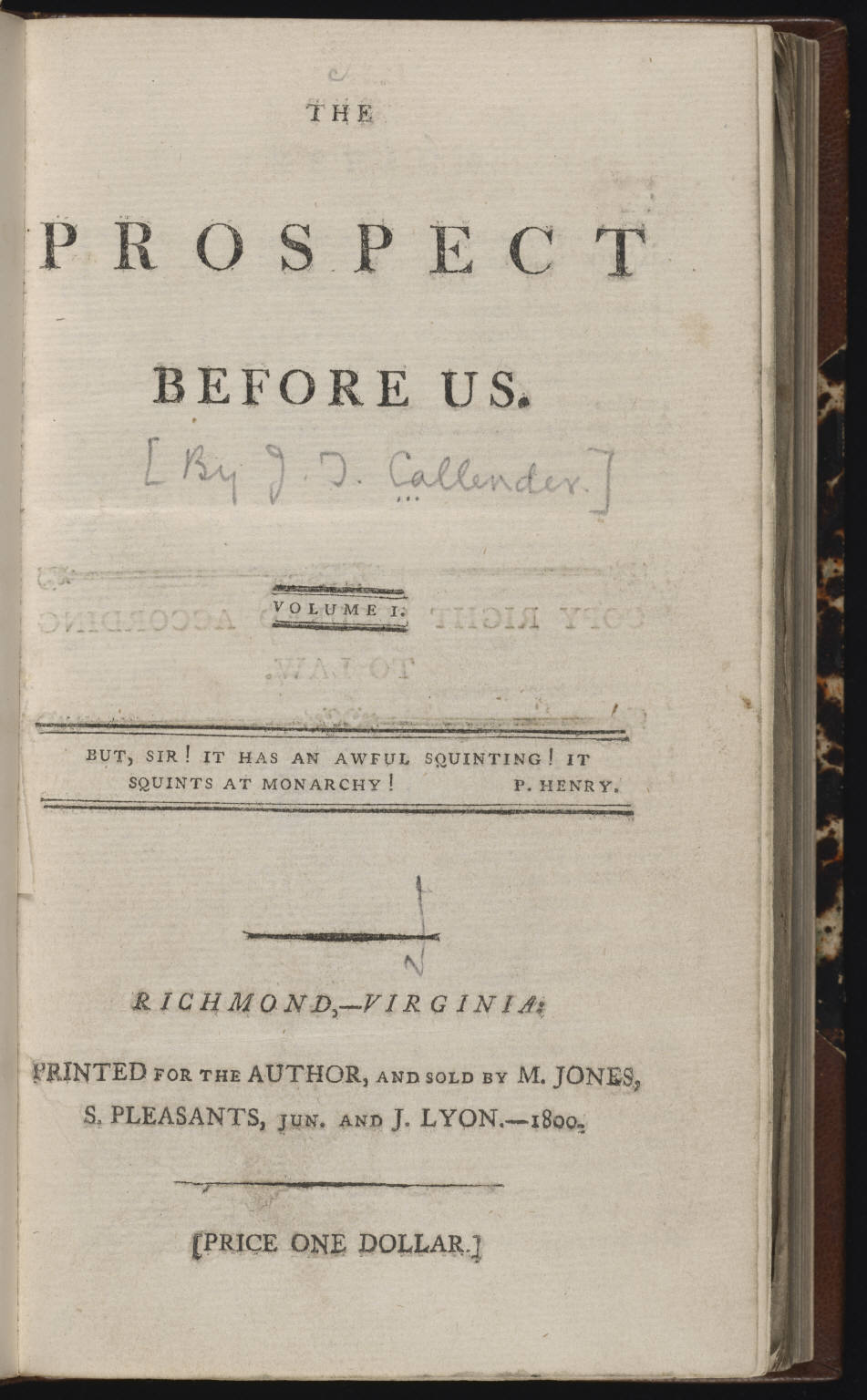
                For writing the "Prospect before us" Jefferson paid and praised Callendar [sic];[1] and unconstitutionally returned his fine after it had been paid.  When, therefore, such numbsculls as Niles and Mitchell the former admirers of Callendar and the present worshippers of his suborner Jefferson, affect to speak reverendly of the memory of Washington, it is arrant dissimulation.   It is impossible for the same heart to contain both sentiments; one must jostle with and displace the other.

               Among other fiend-like aspersions and outrages upon the dead hero, paid for by the infamous Jefferson, take the following as a sample:

From the "Prospect before us"

               "The REPUBLICANS[2] were extremely well satisfied with the demise of the general!!!!  They felt and feared his weight in the scale of aristocracy but they found it necessary to preserve appearances with the multitude, by presenting an appearance of sorrow -  With regard to the mausoleum, the man who shall vote one shilling for it must outgo the guilt of the robber and the house-breaker without their personal temptation.  A plain tablet may perhaps be found expedient as a sacrifice to popular ignorance and enthusiasm."[3]
[p.70.

Callender's Pamphlet
image: Wikipedia


[1] The Sedition Act Trials — Historical Background and Documents.
History of the Federal Judiciary. [accessed April 2, 2013] http://www.fjc.gov/history/home.nsf/page/tu_sedition_hd_jc_indictment.html
"James Callender was the author of some of the most extreme and provocative language penned by any of the Republican newspaper writers during the Adams administration. After gaining notoriety for newspaper editorials in Philadelphia and Richmond, Callender was indicted in the U.S. Circuit Court for the District of Virginia for writing a lengthy pamphlet in favor of Thomas Jefferson’s election as President. The Prospect Before Us took the form of a political history of the 1790s, with special emphasis on the supposed corruption and monarchical principles of John Adams and his administration. Jefferson reviewed a draft of the pamphlet and predicted, in an intentionally unsigned letter to Callender, that “such papers cannot fail to produce the best effect.” Callender made sure that his pamphlet was reprinted in several cities, and he brazenly sent a copy to President Adams."
[2] The Democratic-Republican Party was the political party organized by Thomas Jefferson and James Madison in 1791-93. It stood in opposition to the Federalist Party and controlled the Presidency and Congress, and most states, from 1801 to 1824. from Wikipedia see also: Federalist Party vs. Democrat-Republicans
[3] Federal Republican & Commercial Gazette; Date: 04-02-1810; Volume: I; Issue: 153; Page: [2]; Location: Baltimore, Maryland
Transcribed by John Peter Thompson