Showing posts with label 1812. Show all posts

Tuesday, July 23, 2013

Wheat and the Hessian Fly in Maryland 1812 - Advice to Farmers

Poulson's American Daily Advertiser.;
Date: 07-28-1812;
Philadelphia, Pennsylvania
Rural Economy:
-
TO FARMERS:
               The following method is recommended to preserve Wheat for years from the fly that prevails more or less every year in Virginia, Maryland and Pennsylvania, Delaware and Jersey, and more particularly on the Bays, Rivers and adjacent country.[1]
               Get your wheat out of your straw as early as you possibly can; clean the straw well from the chaff and wheat; if you have a barn, put your wheat away in bulk, leaving the chaff with it.  I knew wheat kept several years during the Revolutionary War in this way free from all insects. - Rats and mice cannot burrow in this bank, it will continually fall on them.  Those that have not barns may make pens with logs, or fence rails; first laying logs or rails on the earth sufficent to keep the damp from rising to injure the wheat; then cover the floor twelve or eighteen inches thick with with straw well tread down - put your wheat on this floor miced with all its chaff, and as you fill the pen, line the sides well with straw; when you have filled your pen in this way, stack your straw on the top of it, seeing that the straw extends well over the top of the pen to carry off the rain water.              E. K. [2]


[1] Asa Fitch. 1847. Diptera. C. Van Benthuysen and Co., Albany. [accessed July 23, 2013] http://archive.org/details/101187262.nlm.nih.gov

 "The insect which we are about to consider, has for a long period been, at times, a severe scourge, in every district of our country. It is more formidable to us, says Dr. B. S. Barton, than would be an army of twenty thousand Hessians, or of any other twenty thou sand hirelings, supplied with all the implements of war. Hence it has forced itself prominently to the notice both of agriculturists and men of science. No other insect of the tens of thousands that teem in our land, has received a tithe of the attention, or been chronicled with a tithe of the voluminousness that has been assigned to this species. Our scientific journals, our agricultural magazines, and our common newspapers, have each accorded to it a conspicuous place in their columns. As may well be supposed, almost every point in its history, has by one and another of its observers, been closely investigated, and laid before the public. Very little that is  new, can, therefore, at this day be embodied in an account of this species. The most that an observer can accomplish, is to add his testimony in confirmation of facts that have been already announced. The most that a writer can aim at, is to gather the various papers that are scattered through volumes sufficiently numerous of themselves to form a library, sift from them whatever they contain of importance, and arrange the facts thus acquired, into a connect ed and symmetrical memoir. Such is the object of the present essay ; to carefully review the various accounts that have been hitherto published, extract from each the items of value which it contains, compare these with personal observations made under favorable circumstances during the past twelve months, and with the materials thus acquired, rite out a history of this species, more ample in its details than any that has been hitherto attempted, and containing a complete summary of all that is known of this insect down to the present day."   


J. W. Chapin, Extension Small Grain Specialist, Department of Entomology, Soils, and Plant Sciences, Clemson
University, Edisto Res. & Ed. Center, 64 Research Road, Blackville, SC 29817. 803-284-3343-ext. 226 jchapin@clemson.edu. [accessed July 23, 2013]

"The Hessian fly, Mayetiola destructor (Say), got its common name from the belief that it was introduced
to North America in the straw bedding of Hessian mercenaries during the Revolutionary War. It was
first reported attacking small grain on Long Island in 1779. By 1845 it was causing damage in Georgia and
has remained a sporadic pest of wheat in the South. Hessian fly can cause economic injury anywhere in
South Carolina, but fields in the southern Coastal Plain usually have greater risk.

Annual damage exceeded $4 million dollars in several outbreaks from 1984 -1989. Contributing factors for severe infestation include use of a susceptible variety, early planting, unusually warm Nov. – Dec. weather, reduced tillage into wheat stubble, volunteer wheat, and lack of rotation. Hessian fly attacks wheat, triticale, barley, and rye in that order of damage severity. Oats are not affected."

[2] Poulson's American Daily Advertiser.; Date: 07-28-1812; Volume: XLI; Issue: 11131; Page: [2]; Location: Philadelphia, Pennsylvania.
Transcribed by John Peter Thompson, July 23rd, 2013.

Friday, May 24, 2013

Edward Suit of Bladensburg: 1809 - 1850


Edward Suit of Bladensburg

Edward Suit lived in Bladensburg from circa 1820 until his death in 1850; the recorded activities of Suit and his family offer some interesting details about life in Bladensburg in the early 19th century.  Born in 1788 and married in 1809 to Catharine Tolbert/Talbert, Suit served in the Maryland Militia in the War of 1812, in Captain James Veitch’s Company of Infantry.  After the war, Suite farmed land that adjoined the town of Bladensburg on the east - several parcels of the large tract, Columbia, that had been amassed by the Lowndes’ family in the late 18th century.  He also purchased several lots in the town of Bladensburg, including Lots  #21, and #22, and it was in his house in town that he died in August, 1850. [1]

Archival records give us tantalizing bits of information about Edward Suit’s activities in the 1840s.  On 7 March 1844, Suit purchased all of the “goods, wares and merchandise” in the store operated by Joshua Selby in the village of Bladensburg, as well as all of Selby’s household furniture from the same building.  The following week Suit entered into a contract to take on a young African-American boy as an apprentice; this contract gives us information on the apprentice process.  William Beckett and Thomas Clements, both Justices of the Peace and neighbors of Edward Suit, drew up the contract, which bound Suit and young James Galloway, according to the Act of the General Assembly passed in 1839 “for the better regulation of the free negro and mulatto children in this state.”  James, who was not quite six years of age, was the son of a free Negro woman, Sarah Galloway, recently deceased.  By this contract, it was the responsibility of Edward Suit that the boy “learn to labor and all habits of industry after the manner of an apprentice.” And young James was to “dwell with and serve the said Edward Suit . . . until the first day of May A.D. 1859 when . . . . [he]   . . . . shall attain the age of twenty-one years.” During all of this time, James was to faithfully serve his master in all lawful business set to him by Suit, and to behave himself in an orderly and honest fashion toward Mr. Suit and his family.  Suit covenanted to faithfully provide good and sufficient meat, drink and clothing, lodging and other necessaries “fit and convenient for such an apprentice.”   At the expiration of his term Suit was to give to his apprentice “two suits of wearing apparel, one suitable for Sundays and the other for working days.”[2]

Edward Suit did not live to provide the two sets of clothing to James Galloway – he died at age 62 in 1850.   The 1860 census shows that James Galloway, well after his 21st birthday, continued to live in Bladensburg with Suit’s family - the widow Catharine Suit, and her adult son, George Washington Suit.  What happened to James Galloway after this has not yet been discovered – he is not listed in the Bladensburg household of George W. and Catharine Suit in the 1870 census, and a search of Civil War troops is beginning.[3]

One more interesting fact about Edward Suit is that he served as Inspector of Plaster of Paris for the Bladensburg District.  Plaster of Paris was an important item in construction and architectural trim, as well as medical treatment (casts for broken bones), and concern that it “be of good quality, accurately weighted, and well coopered”  occasioned Acts of the General Assembly in 1833 and 1834 to appoint an Inspector of Plaster of Paris in Baltimore.  The following year, the Assembly provided for inspection in Bladensburg, and Edward Suit was appointed to this post in 1847.[4]

.
 By Susan Pearl, May 22, 2013.


[1]  Prince George’s County Land Records AB#2:447, AB#10:483, AB#11:138; Prince George’s County Tax Assessments, 1820-1850;  Brown, Helen W., Index of Marriage Licenses, Prince George’s County, Maryland 1777-1886, Genealogical Publishing, Co. Inc., Baltimore 1973; War of 1812 Pension Records.

[2]  Acts of General Assembly Chapter CLV, 1827;  Prince George’s County Deed JBB#3:378; Federal Census 1850, 1860.

[3] Prince George’s County Will PC#1:438; Federal Census 1850, 1860;  Alexandria Gazette, 26 August 1850. Obituary.

[4] Acts of the General Assembly 1832-1834,  Journal of the Proceedings of the House of Delegates of the State of Maryland.

Wednesday, April 24, 2013

A Fulling Mill opens for Business near Bladensburg in 1812


FULLING MILL.
-
The Subscribers are erecting a FULLING MILL, and enlarging their BLANKET FACTORY, at the Point Mills, about twelve miles from Georgetown, and five from Bladensburg, which will be in operation in October; where Fulling and Dying, will be executed with neatness and dispatch in its various branches, and Cash given or Blankets exchanged for Wool.  Customers that find it more convenient to deliver and receive articles in Geo: Town, will call at the store of RENNER & BUSSARD, who will give Cash, or exchange Blankets, for Wool.

                                                            ELKANA COBB.
                                                            DANIEL BUSSARD.

                                             Sept 7, 1812.[1]


[1] The Courier; Date: 10-21-1812; Volume: I; Issue: 28; Page: [4]; Location: Washington (DC), District of Columbia.
Transcribed by John Peter Thompson, April 24th, 2013. 

Thursday, March 21, 2013

All the way up in Vermont, an explosion in Bladensburg in December of 1812 makes news.


 From the National Intelligencer: All the way up into Vermont, an explosion in Bladensburg on Monday December [21?], makes news.[1] 

               We are informed that the Powder Mills near Bladensburg were on Monday night about 1 o'clock, set on fire as it is believed, by an incendiary.[2]  The fire was discovered in the centre building, and immediately the inhabitants of the neighborhood left their houses.  In about 15 minutes the house exploded, containing about four thousand pounds of powder,  from judicious arrangement of the establishment, the explosion was not communicated to other buildings; and already the operations have been reviewed.  The loss is stated not to have exceeded six thousand dollars (approximately $67,416.00 in 2010[3]); although the explosion was so violent as to have shattered the glass of houses, two miles distant to have raised from the ground large frame buildings, bursting out their windows and doors; and in one instance brealing rafters and beams of a house within an hundred yards.[4]


[1] reference to the explosion in the Alexandria Daily Gazette, Commercial & Political; Date: 12-28-1812; Volume: XIII; Issue: 3836; Page: [3]; Location: Alexandria, Virginia

[2] The mill (Powder Mills) was perhaps adjacent to the location of the Avalon grist mill that George Calvert of Riversdale [PG: 68-5] would built in 1822.  The Calverts had owned mill buildings on that property a decade or so before Avalon Mill was built (see deed RM#15:576 ].

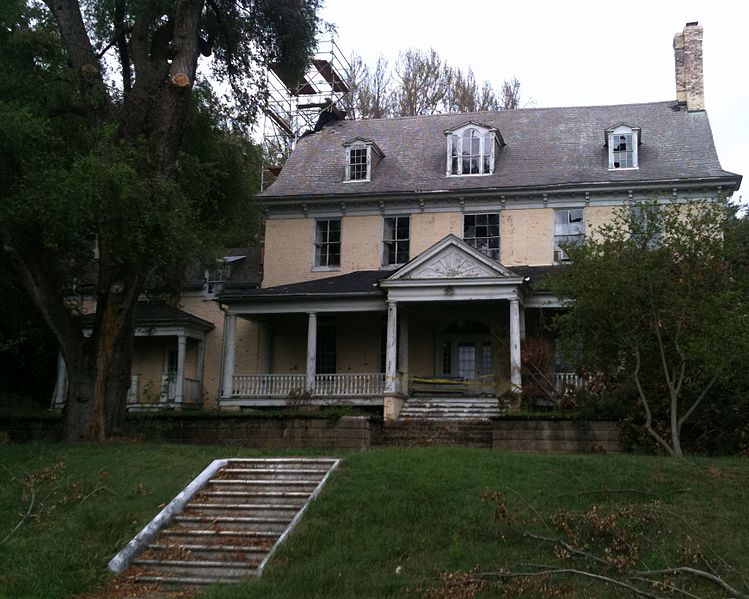
Bostwick House, Bladensburg Maryland
image from Wikipedia
 In July 1812 George Calvert leased to Thomas Ewell of Beall's Pleasure [PG: 75-2], for 12 years, up to 5 acres of land on his mill race for the building of a powder mill. The powder mill was apparently run by Wm. Grayson, J. Stull, and John Williams.

The Powder Mills site maybe roughly at the northeast corner of Bladensburg, along what is now Edmonston Road.

Thomas  Ewell's  father-in-law was Benjamin Stoddert,  President John Adam's Secretary of the Navy, merchant, and real estate speculator.  Stoddert in turn was the son-in-law of Christopher Lowndes of Bostwick [PG: 69-2] in Bladensburg, Maryland.  Thomas Ewell  two sons, Benjamin and Richard, one a President of the College of William and Mary; the other a famed  Lt General in the Confederate Army.

[3] Comparative Value of a 2010 U.S. Dollar (Approximate) [accessed March 20, 2012] http://mykindred.com/cloud/TX/Documents/dollar/index.php?cyear=2010

[4] The Reporter; Date: 01-09-1813; Volume: X; Issue: 505; Page: [3]; Location: Brattleboro, Vermont