Showing posts with label War of 1812. Show all posts

Sunday, October 5, 2014

Heroic Action near Upper Marlborough — The British on their retreat from Bladensburg October 4, 1814

From the political examiner (Frederick, Md.[1])

            Heroic Action — The British on their retreat from Bladensburg left twenty-one men, who were not able to keep peace[sic] with the main army, a shot[sic] distance in the rear. Col. Cross[2], of Prince George's county, observing their isolated situation, hastily collected about 14 of the neighboring militia, and when he came up with the enemy ordered his men to fire and kill every damned rascal of thew stragling [sic] band. The British being panic struck with this order and the firmness with which it was uttered, laid down their arms, but as Col. Cross and his brave comrades advanced to seize them, they were hastily resumed and levelled[sic] with an intention to fire. This did not intimidate our men but on the contrary an impetus to their movements. — They boldly pushed forward when the enemy again laid down their arms. This had scarcely been done before they took them up. Conduct such as this so provoked Col. Cross, that he ordered his small but determined party to charge bayonet and gige[sic] the d____d rascals no quarters. They accordingly advanced with a steadiness and composure, which evinced their resolution to die or conquer; and when in the act of charging, the enemy again threw down their arms and begged lustily for mercy. This was granted and all made prisoners of war. Col. Cross then conducted them to his house, and entertained them at his hospitable board. — They afterwards told him they would have surrendered when he first them to be attacked, but from his fierce and threatening looks they expected nothing short of death. In this short affair, raw militia captured twenty-two of Wellington's choice troops, well armed and equipped. if our militia would generally act in this manner we should soon clear the land of a set of cut-throats abd plunderers.


[1] Green-Mountain Farmer Date: 10-04-1814; Volume: VI; Issue: 11; Page: [2]; Location: Bennington, Vermont.

Transcribed by John Peter Thompson [ October 5th, 2014].

[2] Perhaps: Joseph Cross or Fielder Cross of Prince George's County.

Wednesday, June 25, 2014

June 27th 1814 BARNEY VICTORIOUS!, Deserters, and Sales - Baltimore Patriot


POSTSCRIPT
Sunday Night , 9 o'clock.
            We stop the press to publish the following interesting information, just received from our correspondent at Benedict - - Nat. Int.
            BENEDICT,  JUNE 26
            Sunday morning 6 o'clock
            "There has been since day–break they continued firing in St. Leonard's creek.   Having been this morning on a high hill above this place, I have both seen and heard it.
            The mass of several very large British vessels are distinctly seen with a glass over the land which intervenes, and the smoke of every gun is visible as it rises above the trees.
            We are in fear for Barney, the British having been greatly reinforced, as appears by the number of vessels there. On the first news which reaches us of the results, I will write you."
_________________________
Postscript No. 2. 
BARNEY VICTORIOUS!
Patriot office, 3 o'clock Monday.
            We have just seen a gentleman from St. Leonard's Creek, whose date, that
On Sunday morning Com. BARNEY attacked the enemy, consisting of a razee and frigate, and after an action of one hour and a half, compelled them to set sail and stand down the River —  the Commodore then come [sic] out of St. Leonard's Creek and stood up the Patuxent.
            On their way down, off point patients, the British part Dr. Somerville's house. The British were set fire to three times by hotshot.— Three killed and eight wounded on board the Flotilla.
_________________________
MARSHALL'S SALE.
                                        United States,
Maryland District.
By virtue and pursuance of an order to me directed, from the Hon. James Houston Esq.  judge of the District Court of the United States, in and for Maryland District, will be exposed to Public Sale, at the lower end of Frederick–street Dock, on FRIDAY, the first day of July next, at 11 o'clock, for cash,
The Schooner
MIRA,
her Tackle, Apparel, and furniture, as she now lives.
THOS. RUTTER,  Marshall.
June 24
_________________________
SALE BY AUCTION.
On TUESDAY, the 28th inst. at 10:30 o'clock, at the Auction Room head of Frederick Street Dock
A Variety of Dry Goods,
And at 12 o'clock,
10 pipes French Brandy (high proof & well flavoured, warranted pure, as imported)
50 cases Old Claret, imported in 1810
11/2 pipes Teneriffe Wine
15 cases Martinique Cordial
five have pipes Madeira Wine
12 hhds Muscovado Sugar
50 bags St. Domingo Coffee
10 tierces fresh Rice
three chests Hyson Skin Tea.
                                    Wm. VANCE & Co, Auc'ts
June 25
_________________________
Charitable Marine Society of Baltimore.
The Stated Yearly Meeting of this Society, for the election of officers, collection of dues, and the transaction of other important business, will be held on MONDAY, the 27th instant, at 7 o'clock, P. M. At Pamphillion's Hotel, Fell's Point.
            Punctual attendance of the members is respectfully requested on this occasion; and the payment of all arrearages and dues is most earnestly solicited.
            By order of the Pres.,
NATHANIEL KNIGHT, Sect.
June 23
_________________________
50 Dollars Reward.
DESERTED on the 23d inst. in full uniform, which he may have since changed, WILLIAM HUTTON, born in Cumberland county,Penn aged 27 years, 5 feet, 10 1-2 inches high, fair complexion, grey eyes, black hair and by profession a Shoe Maker, but is fond of driving horses, and has been hired for a siege driver; as a mother and several relatives in Baltimore, where it is supposed he is now lurking. The above reward will be given to any person who will take up said deserter and deliver him to the commanding officer of this place, or by any other officer to whom he may be delivered, who commands a post, Garrison or district.
                             F. EVANS Capt. Art.
Fort M'Henry.
June 24
_________________________
100 DOLLARS REWARD.
On Friday Evening, t10th inst. a White Trunk marked G. Paul, Baltimore, with leather straps buckled on each in, was missed from our store, containing very valuable Goods.
            It may have been delivered to some person in mistake, in which case a generous reward will be given for its return, if required; but is stolen and any of the articles enumerated below offered for sale, we caution the public against purchasing them, and offer a large reward for the chief if convicted of the act, or $100 for the recovery of the goods— contents as follows:

22        India Mulmul embroidered Dresses
16        do                    do        Children's Frocks
7          pieces colored cambric Shawls
2 1-2   do 8-4 Levantine Shawls
5          do embroidered        do        do
8          doz. Ladies' short white Kid Gloves
6          do        Silk Handkerchief
3          band–boxes fringed playing Ribbons, Nos. 3,4, and  4-7
1          band–box Silk Cords, 35 pieces.
                        WM. M'DONALD & SON.
            The National Intelligencer, at Washington will please copy the above eight times, daily.[1]


[1] Baltimore Patriot, published as Baltimore Patriot & Evening Advertiser.; Date: 06-27-1814; Volume: 3; Issue: 151;Page: [3]; Location: Baltimore, Maryland
Column six right side of page complete trasncribed by John Peter Thompson, 25th June 2014

Monday, June 23, 2014

Ravages of the Enemy In Maryland June 24th 1814 - The Weekly Messenger, Boston, Mass.

RAVAGES OF THE ENEMY.

ALEXANDRIA, JUNE 18 — By a gentleman direct from the neighborhood of Barney's Flotilla and the British squadron, who arrived  here  last evening, we have the ,most distressing account of the  situation of the inhabitants of that section of Maryland — A brig of 12 guns and 15 barges were as high up  the Patuxent on Thursday at Benedict — the barges had progressed to Nottingham, a considerable distance  above Benedict.  He states that a number of houses were burnt by them, and other enormities committed — among those were on belonging to Captain Mackall, and one to Mr. Broom — On crossing the ferry at a place called Pig Point  yesterday morning he distinctly saw the barges at Nottingham, and smoke issuing from a house which he was told belonged to General Bowie, and it is probable the whole village is burnt  — A tobacco warehouse has been burnt by them on the St. Mary's side of the Patuxent containing a quantity of tobacco.  He represents the distress of the citizens as extreme  — ­ the  woods and roads full of women and children flying in all directions from their homes. The British lay all the night before last at Lower Marlbro'.[1]


from: Christopher T. George's War of 1812 Blog
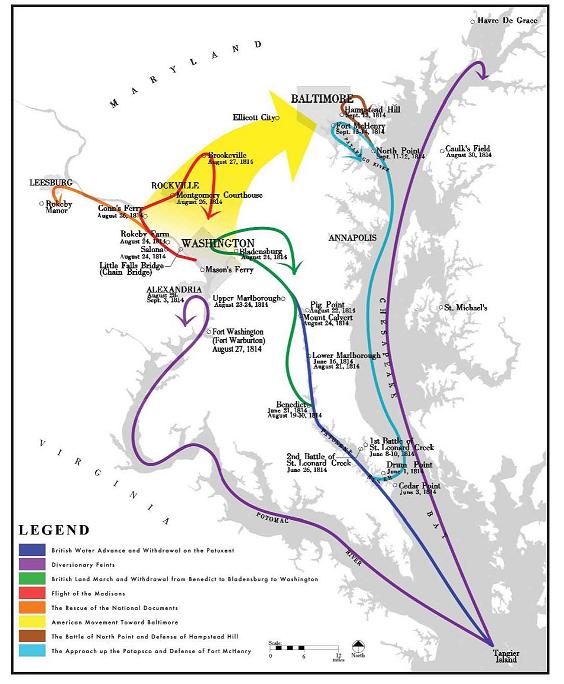
American and British Routes August to September 1814.  The broad yellow arrow shows American troop movements from Washington to the defense of Baltimore: General Ross's British Army returned to their troopships on the Patuxent for the trip up to the city on the Patapsco for a combined land-sea attack (turquoise and brown arrows).


[1] The Weekly Messenger; Date: 06-24-1814; Volume: 3; Issue: 36; Page: [3]; Location: Boston, Massachusetts.

Transcribed by John Peter Thompson: June 14th, 2013.

Saturday, June 14, 2014

Reports from the Patuxent and the Chesapeake Flotilla, June 14, 1814

Alexandria Gazette Commercial and Political; 06-14-1814; Vol: XIV; Issue: 4175; Page: [3]; Alexandria, Virginia
Alexandria Gazette Commercial and Political[1]
06-14-1814

Baltimore, June 11.

CHESAPEAKE FLOTILLA.

            By the Annapolis–Packet, arrived last night, we learn that two expresses have arrived to the governor from Com. Barney, whose Flotilla was at Leonard's Creek, in consequence of which 5 or 6 field pieces had been dispatched to him and a numerous body of militia and volunteers had gone thence from Anne Arundel County to his assistance.

            It was understood the expresses brought accounts that the British had brought all their forces to the Patuxent, and on Wednesday and Thursday made a vigorous attack on the Flotilla principally with Rockets from a brig prepared for the purpose. The firing was of long duration, and no other damage was known to have been done [to] the Flotilla, except that a rocket had fallen on one of the barges, which killed one man and scorched two. Heavy firing was heard yesterday afternoon; supposed another attack.


[1] Alexandria Gazette Commercial and Political; Date: 06-14-1814; Volume: XIV; Issue: 4175; Page: [3]; Alexandria, Virginia. [transcribed by John Peter Thompson, 14 June 2014]

Friday, July 19, 2013

The Enemy is in the Patuxent - July 19th, 1814

THE ENEMY IS IN THE PATUXENT

               An expressed arived on Sunday evening from Gen. Winder stating that the enemy were ascending the Patuxent in great force; orders were immediately issued from the War Department for a detatchment of volunteers to proceed from this city; yesterday about 12 o'clock capt. [sic] Davidson's light infantry, capt. Burch's artillery, and capt. Doughty's rifle companies took up the line of march; the whole under the command of Captain Davidson.[1]

The Enemy in the Patuxent;
Daily National Intelligencer; Date: 07-19-1814;


[1] Daily National Intelligencer; Date: 07-19-1814; Volume: II; Issue: 481; Page: [3]; Location: Washington (DC), District of Columbia.
Transcribed by John Peter Thompson, July 19th, 2013.

Tuesday, July 2, 2013

Ravages of the Enemy - Report from the Patuxent July 2, 1814

American Advocate; Date: 07-02-1814; Volume: V; Issue: 24; Page: [4]; Location: Hallowell, Maine

Monday, July 1, 2013

War in the Chesapeake - Dedham Gazette, July 1, 1814


War in the Chesapeake

               A great degree of alarm, and many war movements - on paper at least, - existed, at the last date, on many of the branches of the Chesapeake.

               In these waters there is considerable British naval force, but the exact number has not been ascertained, - At the entrance of the bay, there is a 74, and other vessels, forming a general blockading squadron.

               In the upper water there is a British 74, the Dragon, Capt. Barrie, two frigates, and a considerable number of smaller vessels and craft; who are opposed to the flotilla of gun-boats and launches, which have been fitted out at Baltimore, &c. at an expense of 50,000 dollars (~$516,700), and commanded by Com. Barney.  This force was declared to have been fitted out for the protection of that city and to be competent to its defence [sic]: But, for some unexampled cause, this flotilla has gotten out of its latitude, and having left the Potapsco [sic], has run into the Patuxent, and carried the war from Baltimore, into one of the most federal counties of the Sate. - The Maryland papers think this movement to be one of the pitiful artifices of the administration, to make the federalists feel the pressure of the war they abhor.

               In a creek of the Patuxent Com. Barney was strictly blockaded by a frigate, and some sloops of war.  This flotilla, from which so much was expected, and of which so much has been vapoured [sic]; being thus disposed of, the British boats and barges have been trying, as Mr. Jefferson would say, how "much harm they can do;" and if a twentieth part of the reports circulated of their doings be true, the people of the vicinity of the Capitol where the war was declared, find it a very "unprofitable contest."  The account states, that the barges had proceeded to Benedict (Maryland), about 15 miles from the creek where the blockading force lay; and where they continued for some time.  It was at this place where Mr. Dorsey met the British Commodore.  As that gentleman's accounts of events appear to me the most responsible, we continue his report of events.

               He says, "the British loaded their barges from the schooner which was aground, and conveyed it on board a privateer: - That while waiting events, near Benedict, " he had the mortification to see a brig, and a number of barges coming from St. Leonard's creek, for the evident purpose of saving the American merchants the trouble of looking out for shipping to carry their produce to market, by becoming themselves the carriers of our tobacco to the fine markets which the present state of the continent is likely to produce."  He adds, "if this tobacco is lost, the British will have taken from the public warehouse on this expedition, at least seventeen hundred and fifty hogsheads.  I can form no opinion of the length of time necessary to load their brig, and am convinced from the nature of the county, they can only be resisted by artillery."  He then hopes the President will order some heavy artillery to prevent the brig from regaining St. Leonard's creek. -  He concludes his letter of the 18th June saying, " You have no conception of the universal panic which prevails here.  The regulars who were stationed in Benedict lost a part of their baggage and provisions.  Believing I can be of no further service here, I return home," &c.

               The barges are said to have attempted to take Nottingham (Maryland), where there were large public warehouses with tobacco in them, and which is only 22 miles from the capitol in Washington; but were discharged of some heavy guns then on their way to St. Leonard's creek.  There are other accounts of similar events; but they are all, probably, the fabrications of newsmakers.

               It is added, that barges plundered on both sides of the river, unmolested. - They declared their orders to be to burn every house which was deserted, or where the stock was removed from the farms.  Provisions they said they wanted, and would have by purchase or force.  They burnt the public ware-houses at Lower Marlborough 5 miles from Benedict, &c.  Thus it appears a contemptible force has carried the war to within a few hours march of Mr. Madison's palace (the White House) without any resistance; and this too, in a narrow river and after we have been two years at war!  The people call for the "defence" [sic] which the Constitution declares the General Government shall give them, and for which they have paid scores of millions; they ask for arms, ammunition and provisions; and they are answered that the government troops are gone to take Canada; and if any succor is sent, it arrives after the enemy has retired.

               By the Georgetown and Washington papers it appears, that the British have evacuated the town of Benedict, and returned down the river.  The quantity of tobacco carried away, and destroyed by the British, during their excursion up the Patuxent, is computed at 8000 bdds.

               It is generally believed that they are now about to concentrate all their force for another attack upon Barney's flotilla.

               The people of that part of Maryland which is now the seat of war, are represented as being extremely exasperated at the President for leaving them in the exposed aituation.  A letter from Leonardstown [sic], after mentioning the consternation and sufferings of the people, adds - " But these are only exceeded by the high-state of irritable sensibility discovered by all classes of citizens, of whatever party, with scarcely an exception, whenever Madison's or Barney's name is mentioned.  The dethroned tyrant is scarely [sic] more execrated by the people of Paris, Lyons or Bordeaux, than our President is by the good people of Calvert, Charles, and St. Mary's (counties).  Curses are poured out upon him daily by thousands of mouths, for bringing the enemy upon them without affording protection.  Old Major _______ has spoken his mind fully to Barney, and the language in which he vented his indignation is a fair sample of the general feeling among the people."  - [Centinel. [1]


[1] Dedham Gazette; Date: 07-01-1814; Volume: 1; Issue: 46; Page: [2]; Location: Dedham, Massachusetts.
Transcribed by John Peter Thompson, July 1st, 2013.

Saturday, June 29, 2013

Barney's flotilla moves up the river to Benedict, Maryland - reported June 28, 1814

BARNEY'S FLOTILLA.

               We have been favored with the perusal of a letter from Benedict [Maryland], dated on Sunday evening, stating that the flotilla in which was blockaded in St, Leanoard's creek, had fought its way into the Patuxent, and had arrived before Benedcit.  The blockading force consisted of a 74, a razee, and 2 frigates.  The loss on board the flotilla it is stated, was five killed and seven wounded.  The enemy's loss not known, but supposed to be considerable.   

               It is verbally stated, that the gunboats were dismantled and left behind, the barges only escaping.

               We have not been able to obtain any further particulars - the general facts are no doubt as above stated. [1]


[1] Federal Republican; Date: 06-28-1814; Page: 3; Location: Georgetown, District of Columbia.
Transcribed by John Peter Thompson, June 29th, 2013.

Thursday, June 13, 2013

Com. Barney, to the Secretary of the Navy, dated Patuxent, St. Leonard's Creek, June 9th, 1814

                                                                                          WASHINGTON, JUNE 11.
Extract of a letter from Com. Barney, to the Secretary of the Navy, dated Patuxent, St. Leonard's Creek, June 9th, 1814.[1]
               "Since mine of the 3d and 4th inst. the enemy has been reinforced with a Razee and a sloop of war brig; I then moved up to the mouth of this creek. _ At [5] A. M. yesterday we perceived one ship, a brig, two schooners, and 15 barges coming up the Patuxent, the wind at East.  I got the flotilla under way and moved up the creek about two miles, and moored in line, abreast, across the channel, and prepared for action.  At 8 A. M. the enemy's barges came up the creek; the ship, &c. anchored at the mouth of the Creek; a Rocket barge [2] was advanced upon us; we fired several shot to try the distance, which fell short.  I got my barges (13 in number,) under way, leaving the Scorpion [3] and gunboats at anchor[.] and rowed down upon them, when they precipitately fled from their position behind a point and sailed and rowed off with all their means.  We pursued them until near the shipping - fired several shot among them, when we returned to our morrings.  In the afternoon they came up again --again threw rockets, and were again pursued out of the creek.  The militia under col. Taney [4] are on the alert.  I am this moment informed the ship, &c, have entered the mouth if the creek.[5]  

The shape and arrangement of sails on an American privateer schooner, brig or brigantine, are quickly movable to much more radical angles. English seamen have written that they saw privateers escaping "sailing directly into the wind." -  
Credit:   US Navy Historical Center  http://www.xray-mag.com/content/us-navy-shipwreck-war-1812-be-excavated


[1] The First Battle of St. Leonard’s Creek: 10 June 1814. Naval History Blog. 2010. {accessed June 13, 2013] http://www.navalhistory.org/2010/06/10/the-first-battle-of-st-leonard%E2%80%99s-creek-10-june-1814

"The battle off Cedar Point, Maryland, on 1 June ended in a draw with the Americans retreating to the safety of St. Leonard’s Creek, Maryland, and the British waiting in the Patuxent River for a reinforcement of smaller, more maneuverable vessels. The British took this potential threat to their naval supremacy in the bay very seriously.

Twice-daily attacks by the British on 8-9 June ended inconclusively. Barney, not relishing a defensive posture, planned a surprise counterattack. On the afternoon of 10 June, as soon as the British boats entered St. Leonard’s Creek, Barney ordered his barges (dismasted for greater speed) to attack the enemy. After a spirited fight, the British disengaged and the Americans pursued, catching the blockading force in the Patuxent unprepared for battle. For a brief time the Americans were ascendant, but soon the British flotilla chased the Americans back to their anchorage. Thus concluded the first battle of St. Leonard’s Creek or the battle of the barges.'"

[2] These are the famous Congreve rockets of "red glare" fame in the U. S. national anthem.

[3] USS Scorpion was a self-propelled floating artillery battery in commission with the United States Navy from 1812 to 1814. The Scorpion was sloop-rigged and could also be propelled by oars. She probably was built under contract for the U.S. Navy in 1812 for service during the War of 1812.  from Wikipedia

[4] Archives of Maryland  (Biographical Series) Michael Taney (b. 1750 - d. 1820) MSA SC 5496-050789
War of 1812 Claimant, Calvert County, Maryland

"Michael Taney was born in 1750 to Michael and Jane (Doyne) Taney in Calvert County, Maryland. He was commonly called Miles by his close family and friends. He attended the college of English Jesuits at St. Omer's and later at Bruge, France. Taney married Monica Brooke (1752-1814) on June 25, 1771, at St. Francis Xavier Catholic Church in St. Mary's County. They had the following children: Michael, Roger Brooke (1777-1864), Augustus (1787-1823), Octavius C. (?-1832), Dorothy, Sophia Y., and Alice.

    Taney was involved in Calvert County society, working as a coroner from 1777-1785. He served as the first Lieutenant of the Calvert County Militia from 1776-1778, as a member of the Lower House, Calvert County, from 1781-82, 1784-88, and 1797-98, and as Lieutenant-Colonel, 31st Maryland Regiment, from 1812-1815. As a member of the House of Delegates, Taney moved to abolish property qualifications for voting or holding office in 1797. His sons Michael, Roger, and Octavius all later served in public offices.

    Michael Taney owned approximately twenty-seven slaves in Calvert County, employing an overseer named William Brinkley. In 1814, British officers under the command of Captain Joseph Nourse forcibly removed twenty-one of Taney's slaves from his property, lying on the Patuxent River. The slaves were taken to Captain Nourse's ship, the Severn. Taney believed that his slaves were carried down to the Tangier Islands. At the time Michael Taney relocated his family, furniture, and stock a safe distance away from the family home.

    On July 1, 1819, Taney killed his neighbor John Magruder in a duel. He fled to Virginia, and on July 15, 1819, he conveyed all of his property to his sons, Roger and Octavius C. They, in turn, were to pay him $1,000 a year from the profits of the estate. Michael Taney died circa March 1820, in Loudon County, Virginia, from injuries sustained in a fall from a horse. Two of Taney's slaves returned his body to Maryland for burial in the family cemetery in Calvert County, Maryland."

His son Roger Brooke Taney was born in Calvert County, Maryland, on March 17, 1777.

[5] Baltimore Patriot & Evening Advertiser.; Date: 06-13-1814; Volume: 3; Issue: 139; Page: [2]; Location: Baltimore, Maryland.
Transcribed by John Peter Thompson, June 13th, 2013.

Tuesday, June 11, 2013

War of 1812 - Barney Reports, May 21, 1814

 MARYLAND.                                                                                    BALTIMORE May 21.

FLAG OF TRUCE

            A flag arrived yesterday at 11 A. M. at Annapolis, sent by Admiral Cockburn, with dispatches from Admiral Cochrane at Bermuda, to Mr. Monroe[1]; also letters to Mr. Barclay British agent[2] for prisoners, which have been forwarded to Washington.  My look out boat has returned with the above information - no additional force of the enemy is in our Bay.                  J. BARNEY.[3]


[1] Secretary of State and future President of the United States.

[2] Col. Thomas Barclay was appointed British Consul at New York in 1799. In Nova Scotia he was a member and the speaker of the House of Assembly. During the War of 1812 he was Commissary for the care and exchange of prisoners of war.  As British agent for prisoners in the War of 1812, he resided at "Bostwick," the oldest surviving structure at Bladensburg.

[3] Joshua Barney (6 July 1759 – 1 December 1818) was, born in Baltimore, Maryland, and served in the Continental Navy during the Revolutionary War. He later achieved the rank of commodore in the United States Navy and also served in the War of 1812.  

New-Bedford Mercury.; Date: 06-03-1814; Volume: 7; Issue: 45; Page: [3]; Location: New Bedford, Massachusetts.
Transcribed by John Peter Thompson, June 11th, 2013.

Friday, May 24, 2013

Edward Suit of Bladensburg: 1809 - 1850


Edward Suit of Bladensburg

Edward Suit lived in Bladensburg from circa 1820 until his death in 1850; the recorded activities of Suit and his family offer some interesting details about life in Bladensburg in the early 19th century.  Born in 1788 and married in 1809 to Catharine Tolbert/Talbert, Suit served in the Maryland Militia in the War of 1812, in Captain James Veitch’s Company of Infantry.  After the war, Suite farmed land that adjoined the town of Bladensburg on the east - several parcels of the large tract, Columbia, that had been amassed by the Lowndes’ family in the late 18th century.  He also purchased several lots in the town of Bladensburg, including Lots  #21, and #22, and it was in his house in town that he died in August, 1850. [1]

Archival records give us tantalizing bits of information about Edward Suit’s activities in the 1840s.  On 7 March 1844, Suit purchased all of the “goods, wares and merchandise” in the store operated by Joshua Selby in the village of Bladensburg, as well as all of Selby’s household furniture from the same building.  The following week Suit entered into a contract to take on a young African-American boy as an apprentice; this contract gives us information on the apprentice process.  William Beckett and Thomas Clements, both Justices of the Peace and neighbors of Edward Suit, drew up the contract, which bound Suit and young James Galloway, according to the Act of the General Assembly passed in 1839 “for the better regulation of the free negro and mulatto children in this state.”  James, who was not quite six years of age, was the son of a free Negro woman, Sarah Galloway, recently deceased.  By this contract, it was the responsibility of Edward Suit that the boy “learn to labor and all habits of industry after the manner of an apprentice.” And young James was to “dwell with and serve the said Edward Suit . . . until the first day of May A.D. 1859 when . . . . [he]   . . . . shall attain the age of twenty-one years.” During all of this time, James was to faithfully serve his master in all lawful business set to him by Suit, and to behave himself in an orderly and honest fashion toward Mr. Suit and his family.  Suit covenanted to faithfully provide good and sufficient meat, drink and clothing, lodging and other necessaries “fit and convenient for such an apprentice.”   At the expiration of his term Suit was to give to his apprentice “two suits of wearing apparel, one suitable for Sundays and the other for working days.”[2]

Edward Suit did not live to provide the two sets of clothing to James Galloway – he died at age 62 in 1850.   The 1860 census shows that James Galloway, well after his 21st birthday, continued to live in Bladensburg with Suit’s family - the widow Catharine Suit, and her adult son, George Washington Suit.  What happened to James Galloway after this has not yet been discovered – he is not listed in the Bladensburg household of George W. and Catharine Suit in the 1870 census, and a search of Civil War troops is beginning.[3]

One more interesting fact about Edward Suit is that he served as Inspector of Plaster of Paris for the Bladensburg District.  Plaster of Paris was an important item in construction and architectural trim, as well as medical treatment (casts for broken bones), and concern that it “be of good quality, accurately weighted, and well coopered”  occasioned Acts of the General Assembly in 1833 and 1834 to appoint an Inspector of Plaster of Paris in Baltimore.  The following year, the Assembly provided for inspection in Bladensburg, and Edward Suit was appointed to this post in 1847.[4]

.
 By Susan Pearl, May 22, 2013.


[1]  Prince George’s County Land Records AB#2:447, AB#10:483, AB#11:138; Prince George’s County Tax Assessments, 1820-1850;  Brown, Helen W., Index of Marriage Licenses, Prince George’s County, Maryland 1777-1886, Genealogical Publishing, Co. Inc., Baltimore 1973; War of 1812 Pension Records.

[2]  Acts of General Assembly Chapter CLV, 1827;  Prince George’s County Deed JBB#3:378; Federal Census 1850, 1860.

[3] Prince George’s County Will PC#1:438; Federal Census 1850, 1860;  Alexandria Gazette, 26 August 1850. Obituary.

[4] Acts of the General Assembly 1832-1834,  Journal of the Proceedings of the House of Delegates of the State of Maryland.

Thursday, May 23, 2013

The Cause of the Present War - May 21, 1814


THE CAUSE OF THE PRESENT WAR

               The Congress, who declared the present war, and the people who supported them in the declaration, it appears were totally mistaken, in the causes they ascribed for it.  It was not the commercial appression of England, her illegal blockades, her impressments of our seamen &c. which caused the resort to arms; - it was not, (strange, as it may seem,) on the other hand, the dictation of Bonaparte, who had go the cord so cleverly about our necks, and whose defeat gave such pleasant slumber to Mr. Harper[1], which produced it.  No, no.  Here follows the detection of the true "desideratum,"  and the sympathy which it causes, is really appropriate and natural.  The article is from a violent Massachusetts tory print.

               The next news from that quarter, will probably furnish the great desideratum for which this war was waged, that is - the possession and governmet of the immense and fertile tracts of land, of which these unfortunate denizens of the woods were the rightful owners; not by conquest or plunder, but by natural inheritance.

            How perfectly and natural and obvious all this is, but no one but this wise gentleman happened before to think of it.  Our rulers, it appears, declared war against Great Britain, simply for the purpose of cheating the Indians out of their land!  What a craving for land our government seem to have!  First they bought the Louisianian woods, and now they have fought for the Canadian wilds.

            But for the poor Indians. - Alas how melting are the plaints of their weeping condoler!  Is the massacre at Fort Mims forgotten?[2] Is the massacre at Fort Mims forgotten?  Did the ornament, which accompanied the mace [sic] at York, the capital of Upper Canada indicate n[] state of humanity, which could call for such tender sympathy?[3]- It is all of a piece, however.  If fear of superior force did not deter our internal foes from displaying their real temper, it would be a matter of indifference, whether an American, faithful to the republican administration fell into the hands of an English Hampton ruffian, a Creek Indian, or an Essex tory.[4]


[1] Heidler and heidler. 2004. Encyclopedia of the war of 1812. Annapolis, Md.  Naval Institute Press.

John Adams Harper (November 2, 1779 – June 18, 1816) was elected as a Democratic-Republican from New Hampshire to the Twelfth Congress (March 4, 1811 – March 3, 1813). He was a key member of the War Hawk faction that strongly supported the War of 1812. 

[2] "The Fort Mims massacre was a battle that occurred on 30 August 1813 during the Creek War, when a force of Creek people, belonging to the "Red Sticks" faction under the command of head warriors Peter McQueen and William Weatherford, or Lamochattee (Red Eagle), stormed the fort and defeated the militia garrison. After the defeat of the garrison there ensued a massacre and almost all of the remaining Lower Creek, white settlers, and militia at Fort Mims were killed. The fort was a stockade with a blockhouse surrounding the house and outbuildings of the settler Samuel Mims, located about 35 miles north of present-day Mobile, Alabama." from Wikipedia.

[3]  "The Battle of York was a battle of the War of 1812 fought on April 27, 1813, at York, Upper Canada (present day Toronto) on the north-west shore of Lake Ontario. An American force supported by a naval flotilla landed on the lake shore to the west, defeated the defending British force and captured the fort, town and dockyard. The Americans themselves suffered heavy casualties, including Brigadier General Zebulon Pike who was leading the troops, when the retreating British blew up the fort's magazine. The American forces subsequently carried out several acts of arson and looting in the town before withdrawing." from Wikipedia.

[4] Baltimore Patriot & Evening Advertiser.; Date: 05-21-1814; Volume: 3; Issue: 120; Page: [2]; Location: Baltimore, Maryland.
Transcribed by John Peter Thompson, May 22, 2013.

Thursday, May 16, 2013

Arson at Navy Yard Foreshadows Things to Come - May 1814


Washington, May 14.

               The evening before the last an unsuccessful effort was made by some incendiary to set fire to one of the old frigates lying at the navy yard in this city, and thus, to burn up the new frigate building near to the old one.  The attempt was doubtless that of a British partisan, since it is difficult to conceive a motive on the part of any other person for committing so at[]rocious an act and you well know that the British cabinet employs incendiaries and agents in every quarter of the world, to effect by their plots and intrigues, what it cannot do by an open course of policy, the aggrandizement of England and English commerce, and the depression of other nations in their march to greatness.[1]
                                                                                                                        [American


[1] Baltimore Patriot & Evening Advertiser.; Date: 05-16-1814; Volume: 3; Issue: 115; Page: [2]; Location: Baltimore, Maryland.
Transcribed by John peter Thompson, May 18th, 2013.

Thursday, May 9, 2013

More News of the British in the Potomac river May 1814


Annapolis, May 7.

               In consequence of an order from Col. Carberry, a detachment of the 36th regiment, under the command of Major Stuart, left this city yesterday at 12 o'clock for Leonardtown, in St. Mary's County.  Itt is said the British are fortifying Blackston's [sic] island, in the Potomac, with the view of landing their sick.  We believe it is the intention of Col. C. to dislodge them if possible.  Com. Barney is near the mouth of the Potomac, we are told, with a part of the Chesapeake flotilla, (about 17 sail.)  If this information should prove correct, the circumstance will tend much to favor any operation which may be in contemplation.[1]


[1]  Daily National Intelligencer; Date: 05-09-1814; Volume: II; Issue: 421; Page: [3]; Location: Washington (DC), District of Columbia.
Transcribed by John Peter Thompson, May 9th, 2013.